The ABCs of AI: Keeping Children Safe
Principles for designing high-quality digital experiences for children and families
by: Michelle Kaplan, M.A., Director, Digital Learning Design
Sesame Workshop has harnessed the power of media to help children learn for 57 years and counting. In the late 1960s, Sesame’s founders set out to see if television could be used to teach young children, particularly those who had no other access to quality early learning. Since then, we’ve leveraged many emerging technologies to do the same. The latest innovation, artificial intelligence, has vast applications — and implications — but Sesame’s principles and proven model remain unchanged: everything we create centers the needs of young children and is grounded in clear educational curriculum and research.
We know that a child’s brain develops fastest in the first five years — and that the primary way a child learns is through engagement with caring adults. In this critical window, we have both an opportunity and a responsibility: an opportunity to help young children build a foundation for lifelong learning and a responsibility to ensure that young children’s developmental needs are incorporated directly into the design of any technology or media that families use.
To that end, we’ve developed these five design principles — our “AI ABCs” — that highlight both the potential and the risks of AI and set critical guardrails around it.
Age-Appropriate Design
Inspire Real Learning
Advance Accessibility
Build Personalization with Room for Discovery
Complement the Circle of Care
We created these best practices to guide our own thinking — but we believe they are applicable to any media creator or technology platform developing content, products, or programs for families with young children.
These are just the headlines. Dive a little deeper below for more context on our AI ABCs and the thinking behind them — or download them here.
And see our AI Tips for Families: AI Tips: What Families Should Know
Full Preview:
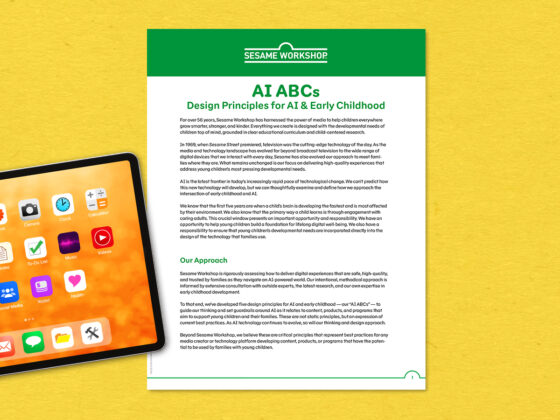
AI ABCs Design Principles for AI & Early Childhood
For over 56 years, Sesame Workshop has harnessed the power of media to help children everywhere grow smarter, stronger, and kinder. Everything we create is designed with the developmental needs of children top of mind, grounded in clear educational curriculum and child-centered research.
In 1969, when Sesame Street premiered, television was the cutting-edge technology of the day. As the media and technology landscape has evolved far beyond broadcast television to the wide range of digital devices that we interact with every day, Sesame has also evolved our approach to meet families where they are. What remains unchanged is our focus on delivering high-quality experiences that address young children’s most pressing developmental needs.
AI is the latest frontier in today’s increasingly rapid pace of technological change. We can’t predict how this new technology will develop, but we can thoughtfully examine and define how we approach the intersection of early childhood and AI.
We know that the first five years are when a child’s brain is developing the fastest and is most affected by their environment. We also know that the primary way a child learns is through engagement with caring adults. This crucial window presents an important opportunity and responsibility. We have an opportunity to help young children build a foundation for lifelong digital well-being. We also have a responsibility to ensure that young children’s developmental needs are incorporated directly into the design of the technology that families use.
Our Approach
Sesame Workshop is rigorously assessing how to deliver digital experiences that are safe, high-quality, and trusted by families as they navigate an AI-powered world. Our intentional, methodical approach is informed by extensive consultation with outside experts, the latest research, and our own expertise in early childhood development.
To that end, we’ve developed five design principles for AI and early childhood — our “AI ABCs” — to guide our thinking and set guardrails around AI as it relates to content, products, and programs that aim to support young children and their families. These are not static principles, but an expression of current best practices. As AI technology continues to evolve, so will our thinking and design approach.
Beyond Sesame Workshop, we believe these are critical principles that represent best practices for any media creator or technology platform developing content, products, or programs that have the potential to be used by families with young children.
AGE-APPROPRIATE DESIGN
AI-supported experiences for young children must be designed around their core developmental needs.
Developmentally appropriate design is at the core of everything Sesame Workshop creates. Features are designed to meet the cognitive, physical, and social-emotional developmental needs of our young audience, and digital experiences must align with clear, research-based educational goals. AI-supported experiences must follow the same rigorous design standards, with additional guardrails to keep children’s developmental needs front and center.
Because young children are still learning what’s real and alive, AI products may be mistaken for sentient beings with real feelings. This confusion risks wrongly influencing a child’s expectations for real world relationships and potentially disrupting essential moments of human connection. Therefore, AI-powered chat or voice features designed for children’s interaction must be clearly identified and never used as a social or emotional companion for young children. AI experiences or products that are anthropomorphic, manipulative, addictive, or sycophantic are not developmentally appropriate. The goal is to put the child firmly in control of their experience, rather than allowing AI to use emotional persuasion or addictive design features to keep children engaged.
INSPIRE REAL LEARNING
AI should support, rather than erode, the development of thinking skills, curiosity, and other skills children need for lifelong learning.
Early childhood education is intentionally inefficient, and the answers are far less important than the learning process to find them. Young children are learning how to learn and develop reasoning skills to help them make decisions, draw inferences, and solve problems. AI can be a tool to support building these uniquely human skills but must not replace them.
AI-supported products should support a child’s thinking rather than circumvent it, by asking open-ended questions to help them arrive at their own answers and by framing mistakes or setbacks as a normal part of the learning process. Outputs should help children draw connections between what they’re learning on-screen to the real world and their daily routines.
AI-generated outputs must be carefully managed to protect children. Responses should draw only from a verified content library — not the open internet — to keep information safe and factual. AI should defer sensitive topics and unknown answers to a trusted caregiver rather than generating a response.
ADVANCE ACCESSIBILITY
AI should help expand learning accessibility, without creating further learning gaps or putting safety features behind a paywall.
Accessible design must always be our universal baseline. AI can support learning accessibility by offering real-time translation, multi-modal approaches, and adaptive tools tailored to the needs of each child and their family. However, these benefits only matter if they work for the families who need them most, especially those in underserved communities.
Yet, as AI closes some gaps in access, it must not open new ones. Products should be marketed as a complement to educators, therapists, and social workers, not as a substitute for the human care and expertise that underserved families may already struggle to access. Designs should function well across a wide range of devices and connection speeds and should account for any inherent biases in the underlying technology. AI-supported products must make accessibility and safety the standard for every user — essential safety, privacy, or developmental features should not sit behind a paywall.
BALANCE PERSONALIZATION WITH ROOM FOR DISCOVERY
AI personalization should balance the ability to deepen a child’s existing interests with the need to broaden their learning through curiosity, exploration, and the discovery of new ideas.
AI can be used to curate content tailored to the needs and interests of children to help them stay engaged, match their pace and sensory needs, and deepen learning. However, when AI curates content based on a child’s existing preferences, it also risks narrowing their world instead of expanding it — during a critical window for brain development.
Personalization shouldn’t come at the expense of new ideas and ways of learning that can spark curiosity and discovery. Child-facing AI products must balance reinforcing a child’s expressed interests with intentional exposure to a range of new content, themes, and ideas — pulled from a verified library. This personalization often requires the collection and use of personal data, which must be managed in a safe, highly controlled manner. Data collection must be strictly limited to only what is required for a given feature to function, and this information must never be used for third-party marketing or other exploitative purposes.
COMPLEMENT THE CIRCLE OF CARE
AI-supported experiences should never replace critical human connection between children and caregivers, and if used at all, should enhance those connections.
AI can be a powerful tool for parents and caregivers to reduce cognitive load by helping with practical, logistical tasks in service of freeing up time for deeper engagement with their children. For example, AI can pull from a trusted content library to offer advice on low-stakes parenting questions; support translation between providers and families; and foster adult-child connection by providing personalized ideas for offline engagement. The goal of any parent-facing AI experience should always be to increase and deepen off-screen connections between adults and children, not reduce them.
The back-and-forth “serve and return” exchange that happens in daily conversations and interactions between a child and their caregiver are essential to healthy development. These moments help a child learn the social-emotional skills they’ll need to navigate relationships throughout life — and forge a deep connection with their core caregivers. Adult-facing AI products must be designed to protect the bond between caring adult and child, and never to substitute core caregiving engagement. Guidance offered to caregivers must be carefully managed for safety and validity, providing clarity wherever possible on what sources inform AI outputs and what outputs still require careful human review.